
You've connected an AI employee to Gmail, Slack, HubSpot, and Stripe. A lead disappears from the CRM, a support ticket reopens, and a payment-related message is sent, but each system shows only part of the story. You can see activity everywhere, yet you can't answer the operator's basic questions: what happened, when did it happen, which agent or user caused it, and was the action authorized?
That gap is where operational data matters. It's the continuously generated record of business activity and system behavior, prepared not only for reporting but also for immediate decisions, troubleshooting, compliance, and safe automation. This guide builds the concept from the ground up, then applies it to ingestion, storage, data quality, identity-level auditability, and multi-instance AI-agent deployments.
Table of Contents
- What Operational Data Really Means in 2026
- The Four Streams That Make Up Operational Data
- How Operational Data Differs From Other Data Types
- How SourceX Can Help
- Ingestion and Storage Patterns That Keep Streams Decision-Grade
- Governance, Security, and Identity-Level Auditability
- Implementation Checklist for Multi-Instance Deployments
- FAQ and Operator's Checklist
What Operational Data Really Means in 2026
Operational data describes what's happening inside running business systems. It includes transactions, customer interactions, inventory changes, service cases, workflow events, and the signals that explain how those activities moved through connected tools.
The important distinction is that operational data captures current-state activity while preserving enough history to reconstruct change. A CRM snapshot may show that a deal is now closed. Operational records should also help you determine when its stage changed, which integration submitted the update, what value existed before it, and whether an automated workflow was allowed to make the change.
This makes operational data closer to a flight recorder than a passenger manifest. Analytical data might tell you which customers purchased last quarter. Operational data helps explain the sequence of events that led to a purchase, a failed handoff, a duplicate invoice, or an unanswered support request.
Operator's rule: If you can see only the final value, you have visibility into state. You don't necessarily have operational understanding.
A useful working definition is:
Operational data is time-sensitive system-of-record data that records business activity, state changes, actors, and system behavior in a form that supports action and reconstruction.
A clinical-trial operational data warehouse described in a 2019 academic study illustrates the model. It used a dimensional SQL Server database that retained current records and the full history of updates, allowing retrospective analysis and diagnostic investigation instead of limiting users to the latest value.
The four streams below give this definition a practical shape.
| Characteristic | Operational Data | Analytical Data | Transactional Data |
|---|---|---|---|
| Primary question | What's happening, and what just changed? | Why did it happen, and what should we do? | Did this transaction happen successfully? |
| Typical freshness | Current or near-current | Historical and aggregated | Immediate for transaction processing |
| Main users | Operators, applications, agents, support teams | Analysts, managers, executives | Applications and transaction processors |
| History requirement | Reconstructable state and event history | Long-term trends and comparisons | Often focused on transaction integrity |
| Main risk | Stale, conflicting, unauthorised, or unexplained actions | Misleading analysis from poor context | Failed, duplicated, or incomplete transactions |
The Four Streams That Make Up Operational Data
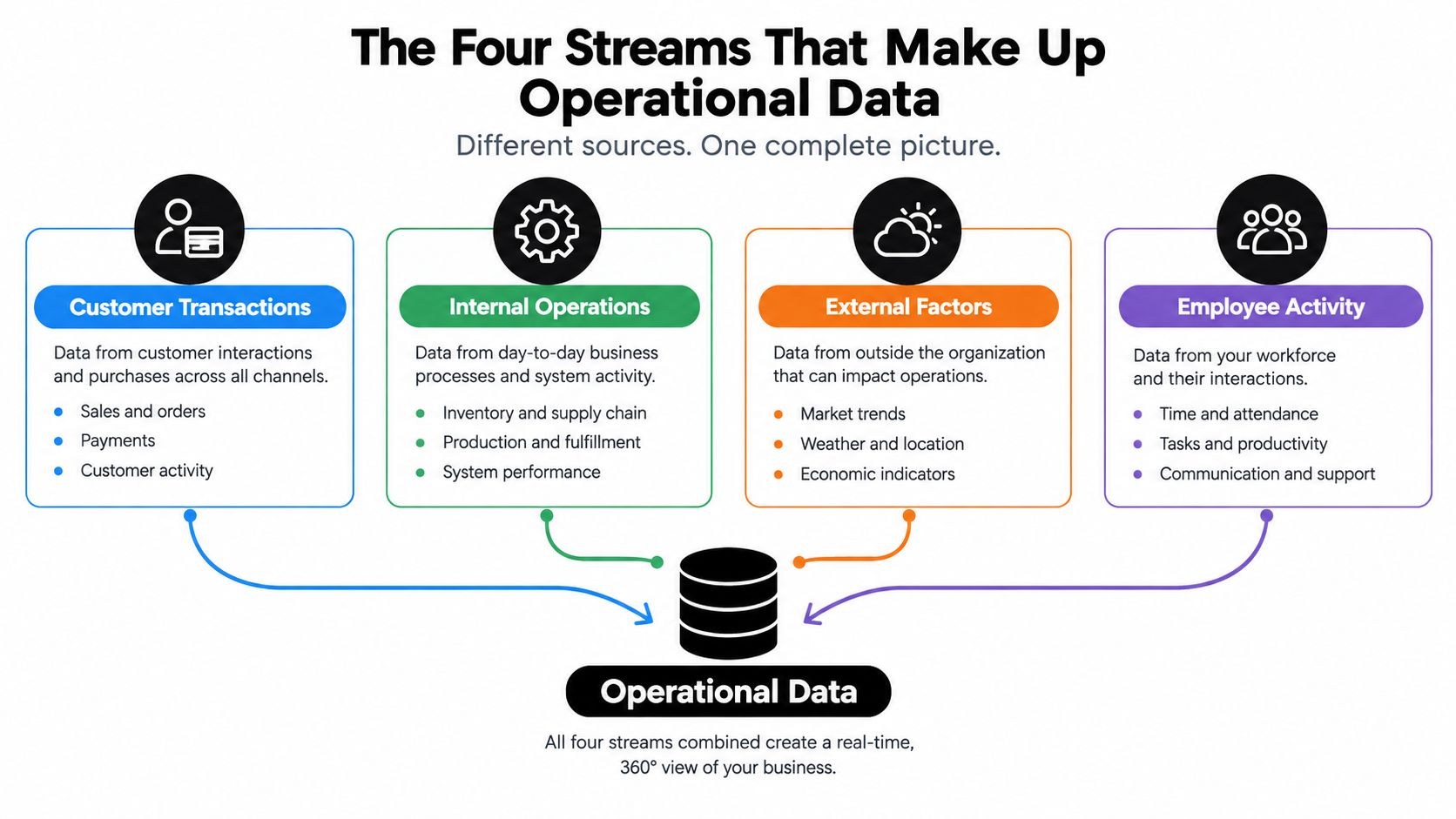
Operational data becomes easier to govern when you separate it into four streams. They may arrive through the same pipeline, but they answer different questions and need different controls.
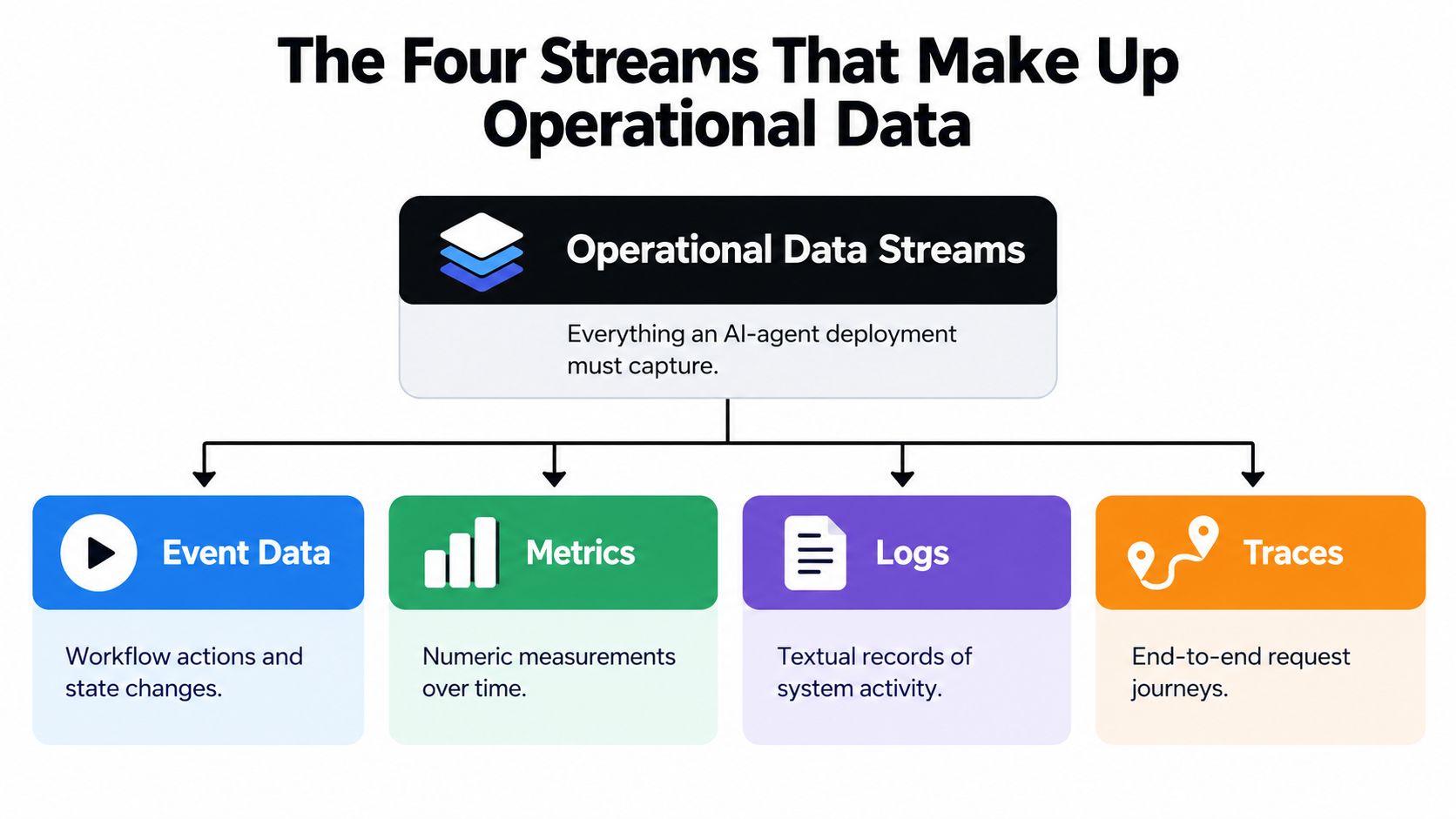
Event data records actions and transitions. A HubSpot deal moving from “qualified” to “proposal,” a Zendesk ticket reopening, or an agent sending a reply are events. Events should carry a timestamp, source identifier, actor, object identifier, and prior and new state where relevant. Without those fields, replay and incident reconstruction become guesswork.
State data records what is true now. Examples include a ticket's current status, a customer's account owner, a subscription's billing state, or an agent instance's connection status. State is what an agent often reads before deciding whether to act. It must be refreshed and reconciled because a correct value from yesterday may be unsafe to use today.
Identity data answers who or what performed an action. The actor might be a human user, an AI agent, an agent instance, a delegated service account, or an external integration. Identity data should connect the action to its tenant, client boundary, authorization context, and tool invocation. A useful audit-log example guide can help teams think beyond a generic “request succeeded” message.
Observability data explains whether systems and integrations are functioning. Logs describe textual activity, metrics show measurements over time, and traces connect a request across services. An OAuth token failure may not change a CRM record at all, but it can explain why an expected workflow never completed.
Why the streams must stay distinct
Treating every record as an undifferentiated log pile creates operational ambiguity. Event data supports replay, state data supports decisions, identity data supports authorization, and observability data supports reliability.
Consider an agent that updates a Salesforce opportunity after reading an email. The event tells you that the opportunity changed. The state tells you its new stage. Identity data tells you which agent instance acted under which user context. A trace can show whether the email retrieval, classification, CRM lookup, and write operation completed as one request.
These records can be linked through correlation IDs, object IDs, timestamps, and instance identifiers. They shouldn't be merged into one indistinguishable stream, because each stream has a different retention, access, and validation requirement.
How Operational Data Differs From Other Data Types
Teams often confuse operational data with transactional data because both are close to live systems. The difference is scope. Transactional data proves that a business operation was committed. Operational data adds the surrounding sequence, current context, actor, system response, and history needed to run and troubleshoot the process.
Master data answers a different question: what is the thing? It defines relatively stable entities such as a customer, product, employee, account, or supplier. Operational records reference those entities as they participate in changing workflows.
Analytical data then takes historical operational and transactional records and organizes them for comparison, forecasting, and management decisions. A warehouse query might reveal that support volume rose after a product release. Operational data helps an operator identify which tickets are open now, which workflows failed, and which agent needs to escalate them.
| Data type | Main question | Typical write pattern | Freshness tolerance | Example |
|---|---|---|---|---|
| Transactional | Did the operation complete? | Controlled application transaction | Very low | Payment captured |
| Operational | What is changing, and who or what changed it? | Events, state updates, agent actions | Low | Subscription status changed after a support interaction |
| Analytical | What patterns explain performance? | Batch or transformed loads | Higher | Quarterly conversion analysis |
| Master | What entity are we referring to? | Governed record updates | Moderate | Canonical customer identity |
The systems also fail differently. A transaction can fail atomically and leave no order. Operational data can fail by arriving late, duplicating an event, losing the actor, or recording a final state without the transition. Analytical data can remain internally consistent while being too old to guide a live response.
That's why a warehouse shouldn't automatically become the agent's decision store. Warehouses are valuable for historical context, but an agent handling a refund, customer reply, or permission change needs current state, authorization scope, and traceable source records. Conversely, an operational store shouldn't replace analytical modeling. Operators need immediate truth; analysts need comparable history and stable definitions.
The practical design is usually complementary: transactional systems protect business commits, operational stores preserve live activity and context, and analytical systems explain patterns over time.
How SourceX Can Help
Operational data can support more than internal automation. Once an organization has mapped its sources, documented provenance, and removed personal details appropriately, it may also have datasets that are useful to AI labs or other data buyers. That use case requires a separate control plane for rights, privacy, contracting, payment, and delivery.
SourceX operates as an enterprise data transaction layer for that process. It can assess licensing fit without requiring an initial upload, map data across business systems and historical records, and create a private inventory describing available fields, depth, source systems, and structure. Supported source categories include exports from tools such as Zendesk, Salesforce, GitHub, Jira, SharePoint, and Google Workspace.
Where the model fits
SourceX is relevant when the problem isn't just storing operational data, but turning it into a rights-cleared, privacy-prepared, buyer-evaluable dataset. The workflow includes provenance review, supplier permissions, dataset-specific deidentification, pricing and licensing terms, buyer evaluation, agreement execution, packaging, and delivery coordination.
Its supplier-control model is particularly important. Data isn't shared until the supplier explicitly authorizes the scope and permitted use, and an evidence packet can document the system of origin, licensing rights, intended purpose, and usage constraints. Suppliers retain ownership of original data, while selected deidentified datasets follow the ownership and confidentiality terms of the agreement.
This is not the right choice for a team that only needs an internal event pipeline, a warehouse, or an agent audit log. It becomes a fit when an enterprise has valuable operational records but lacks the legal, privacy, and commercial workflow to present them to qualified buyers. The operational data licensing resource provides a useful starting point for evaluating that path.
Ingestion and Storage Patterns That Keep Streams Decision-Grade
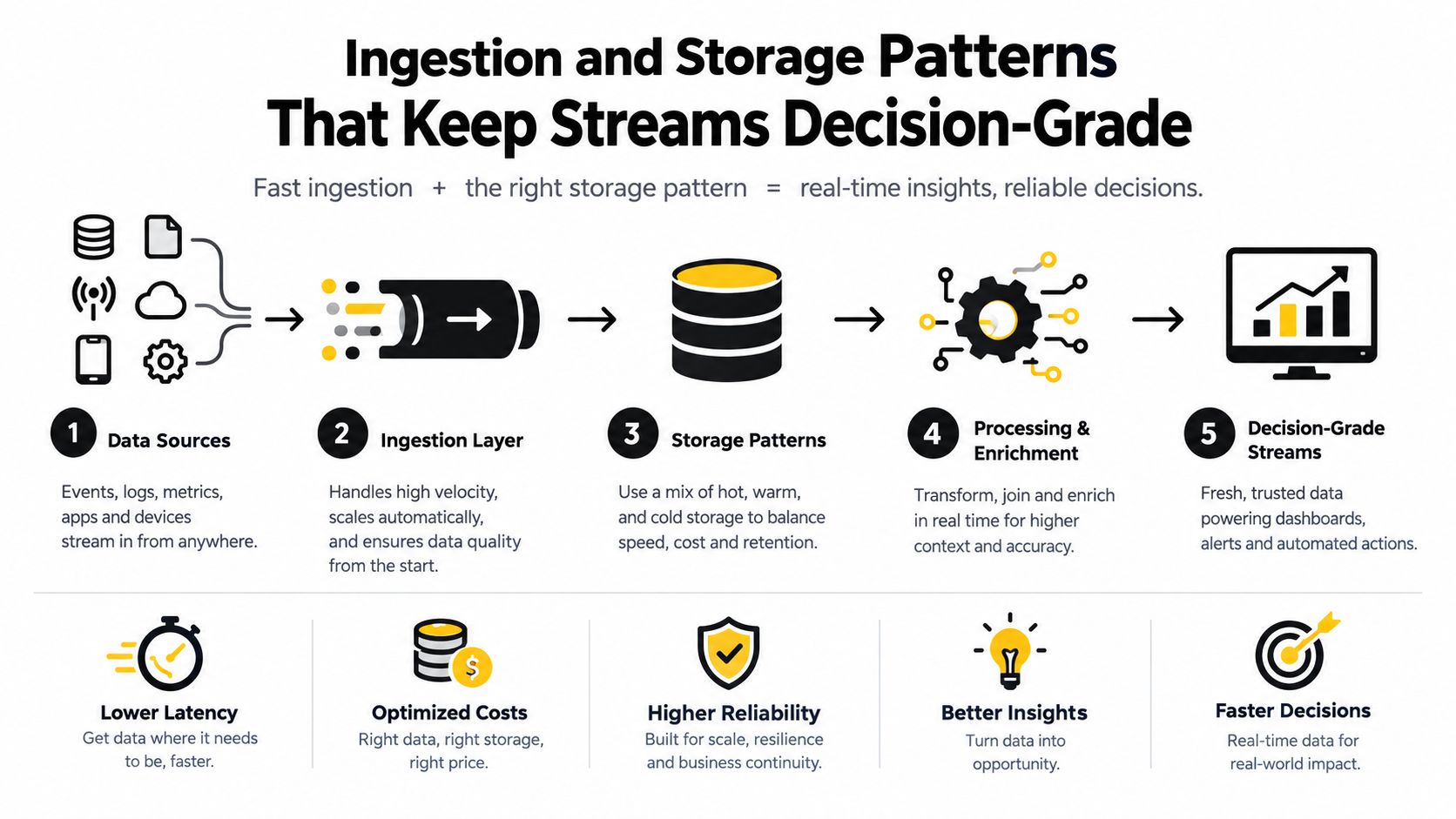
Ingestion determines whether operational data becomes usable evidence or an expensive noise source. A connector that successfully copies records can still produce unsafe input if it drops identifiers, duplicates updates, hides source timestamps, or delivers stale state without warning.
Four patterns cover most deployments.
Change-data capture
Change-data capture reads inserts, updates, and deletes from transactional sources. It's useful for databases where the source of truth is internal and state changes must be preserved. The main failure mode is ambiguous ordering. If updates arrive out of sequence, downstream systems may reconstruct the wrong state unless they retain source timestamps, sequence information, and a reconciliation strategy.
Webhook fan-in
SaaS platforms commonly emit webhooks for CRM updates, support events, payment changes, and workflow actions. Fan-in centralizes those callbacks, but it must handle retries and duplicates. Every event needs an idempotency key or equivalent deduplication method, plus a record of whether processing succeeded.
Agent-emitted events
An AI employee should emit a structured event for each meaningful action, not only a final success message. Include the agent identity, instance or tenant boundary, user authorization context, tool selected, records retrieved, policy or prompt version, action taken, and approval status. This lets an operator distinguish “the agent decided not to act” from “the agent tried to act but the integration failed.”
A data persistence guide is useful when deciding which records must survive restarts, retries, and later investigations.
Consolidated observability pipelines
Logs, metrics, and traces should be correlated before they reach the operator interface. A study of 130 enterprise organizations reported an average of 9.6 million monitoring events per enterprise per year, with only 18% of incidents actionable. The same observability research found that enriched alerts were 28% more likely to produce an actionable response, while 82% of participating organizations achieved at least 97% noise reduction after applying stronger event-management practices.
The lesson isn't to delete raw events. Retain them for auditability, but expose normalized incidents with instance ID, affected integration, severity, owner, recent history, and recommended next action. Hundreds of failures caused by one expired OAuth credential should appear as one correlated incident with linked evidence, not as hundreds of independent tasks competing for attention.
Governance, Security, and Identity-Level Auditability
Operational data isn't automatically decision-grade data. A dashboard can show a current value while hiding stale timestamps, conflicting sources, missing history, or an actor with excessive permissions.
Evidence from a global survey makes the gap concrete. Among 1,200 business and IT decision-makers across seven countries, only 34% rated their data excellent for relevance and suitability, 35% for consistency and standardization, 37% for security and protection, and 43% for quality and completeness. Only 46% were fully confident in data quality, even though 88% said high-quality data is essential to AI success, according to the Riverbed AI and data survey.
Start with a data contract
A data contract defines what an agent may rely on. For each critical field or event, specify:
- Freshness: how old the value may be before the agent must recheck it.
- Completeness: which fields are required for the action.
- Provenance: the originating system, connector, and transformation path.
- Consistency: which source wins when systems disagree.
- Interpretability: the meaning of statuses, codes, and timestamps.
- Retention: how long history must remain available for investigation.
These dimensions align with the six quality dimensions identified by Statistics Canada, relevance, accuracy, timeliness, accessibility, interpretability, and coherence. A record can be accurate yet unusable if it arrives too late, and it can be complete yet unsafe if nobody can explain where it came from.
Add confidence and escalation rules
An agent shouldn't treat every retrieved value as equally reliable. Confidence scoring can combine source authority, freshness, field completeness, conflict status, and the reversibility of the proposed action.
For example, an agent might draft a customer reply when the account owner is missing, but require human approval before changing billing details. It might update a low-risk internal status when the source is fresh and consistent, but escalate when two systems disagree about entitlement.
Practical boundary: The more irreversible the action, the stronger the evidence and approval requirement should be.
Make identity reconstructable
Conventional application logs often show that a service account called an endpoint. That isn't enough when an AI agent dynamically selects tools, retrieves context, delegates work, or acts across client instances.
A useful audit record should preserve:
- Agent identity and instance ID.
- Tenant or client boundary.
- Human authorization context.
- Tool invocation and connector used.
- Records retrieved or referenced.
- Policy, prompt, or workflow version.
- Output classification and confidence.
- Downstream action.
- Approval, rejection, or escalation status.
A data governance framework can help teams formalize those responsibilities across data owners, platform operators, security teams, and business approvers.
A 2025 survey reported that 82% of organizations already use AI agents, while only 44% have policies to secure them. It also reported that 39% had agents accessing unauthorized systems, 33% had agents accessing inappropriate or sensitive data, and only 52% could track and audit all data used or shared by agents, according to Help Net Security's survey coverage.
The implementation consequence is clear. Scope permissions per instance, isolate client data, avoid shared credentials where possible, and record enough context to prove least-privilege behavior after the event. Governance isn't an administrative layer added after automation. It is the evidence and boundary system that makes automation defensible.
Implementation Checklist for Multi-Instance Deployments
A practical rollout has four phases. Each phase should produce an artifact and an exit decision before more agents receive authority.
Instrument
Map the event, state, identity, and observability streams for one workflow. Capture source timestamps, object IDs, instance IDs, actor identity, tool calls, and outcomes. The output should be a centralized view that can answer what happened without opening four unrelated dashboards.
Exit criterion: an operator can reconstruct a successful action and a failed action from stored records.
Validate
Write data contracts for the fields that drive decisions. Add freshness checks, required-field validation, duplicate detection, source reconciliation, and alert correlation. Connect quality indicators to business outcomes such as failed automation, escalation, human override, or resolution delay.
Exit criterion: the agent can detect when input quality is insufficient and stop or escalate instead of guessing.
Govern
Apply role-based access control at the instance and client boundary. Record agent identity, authorization context, retrieved records, policy version, downstream action, and approval state. Test cross-tenant access deliberately, including retries and delegated tasks.
Exit criterion: security and operations teams can demonstrate who accessed what, why access was permitted, and which action followed.
Scale
Only then expand to additional workloads. Standardize schemas, incident categories, retention rules, ownership, and handoff procedures. Centralized monitoring and billing can reduce administrative duplication, but isolation should remain explicit where clients, data owners, or compliance obligations differ.
Exit criterion: a new instance can be provisioned with the same controls without creating a new manual governance process.
FAQ and Operator's Checklist
Use this compact runbook:
- Capture: Record events, state, identity, logs, metrics, and traces.
- Identify: Attach actor, instance, tenant, and authorization context.
- Validate: Check freshness, completeness, consistency, and provenance.
- Correlate: Group repeated failures into actionable incidents.
- Scope: Enforce least privilege per instance and client.
- Escalate: Require human approval for uncertain or irreversible actions.
- Retain: Preserve history long enough to reconstruct decisions.
- Test: Rehearse retries, outages, duplicate events, and boundary violations.
Is operational data just logs? No. Logs are one observability stream. Operational data also includes business events, current state, identity, and historical changes.
When should an agent escalate? When required fields are missing, sources conflict, confidence is low, or the action is difficult to reverse.
How do you prove least privilege? Preserve identity, authorization context, retrieved records, tool calls, policy version, and resulting action in an auditable record.
Should instances be consolidated? Consolidate monitoring where it helps operators, but keep data and permissions isolated where workload boundaries require it.
Define your critical workflows, map the four streams, and test one end-to-end agent action before expanding deployment. If you need a platform for isolated AI-agent instances with scoped access, centralized monitoring, and unified audit records, evaluate the controls against your own runbook and compliance requirements before granting production authority.